Answer to 2026 3rd Quarter “What Herb am I?
What Herb am I? – By Amy Watson, MA, VetMB, MRCVS, GDVCHM, CVA, ACVCHM, CCRT
When practitioners think of Yin tonic formulas, they often think immediately of Di Huang based formulas. But what if the patient is Yin deficient, exhausted and dry, yet not quite ready for the rich, cloying nature of Rehmannia – based prescriptions? What if the Qi also needs support?
That’s where this formula comes in. This formula is one of Zhang Zhongjing’s classical formulas from the Jin Gui Yao Lue (Synopsis of the Golden Chamber), written during the Eastern Han Dynasty around 200 AD. Its original indication was for Lung and Stomach Yin deficiency with rebellious Qi, producing chronic dry cough, dry throat, difficult swallowing and the sensation of Qi rising upwards rather than descending normally. However, modern veterinary practitioners have found its application to extend far beyond respiratory disease.
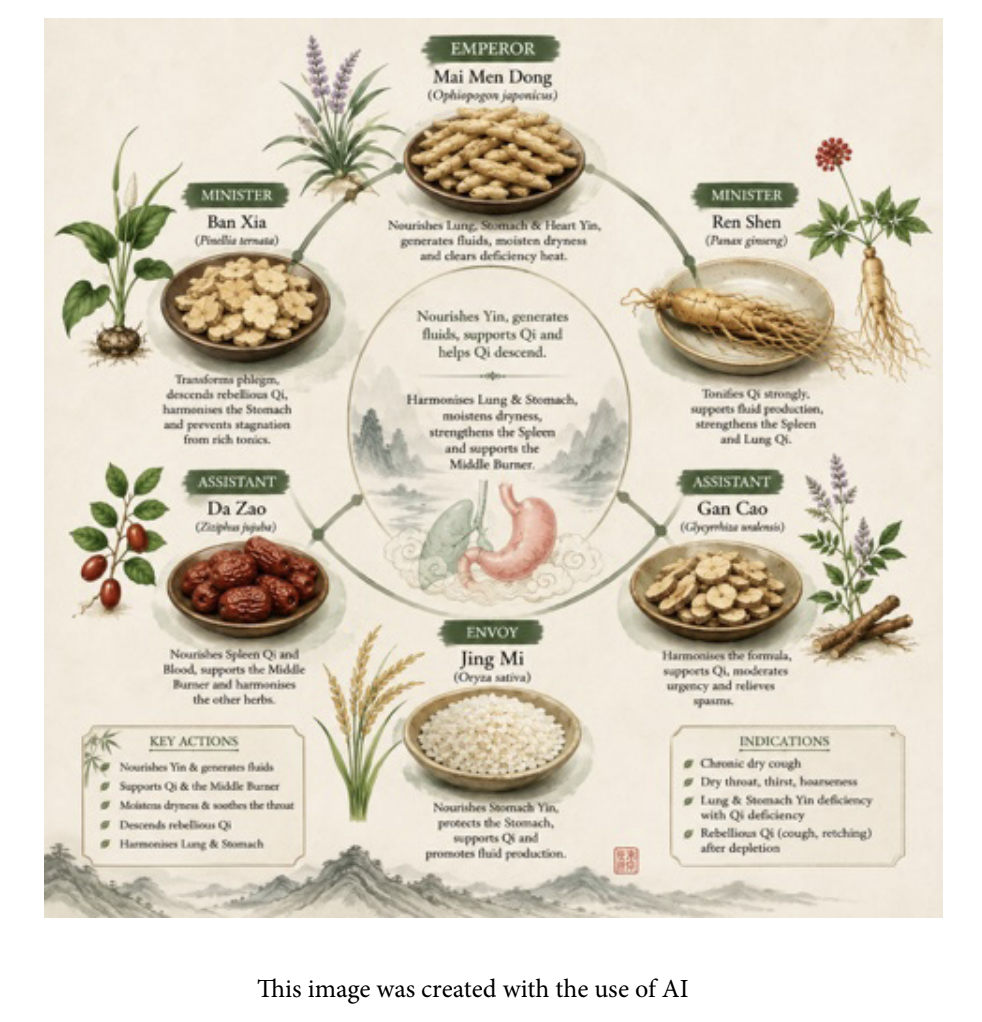
Composition
- Mai Men Dong (Ophiopogon japonicus) – nourishes Lung, Stomach and Heart Yin, generates fluids, moistens dryness and gently clears deficiency heat. This herb is mild in potency so large amounts are required to produce the effects seen.
- Ban Xia (Pinellia ternata) – descends rebellious Qi, transforms phlegm and prevents the rich Yin tonics from causing stagnation.
- Ren Shen (Ginseng) – tonifies Qi, supports fluid production and restores the Middle Burner.
- Da Zao (Jujube) – nourishes Spleen Qi and Blood while protecting digestion.
- Gan Cao (Liquorice) – harmonises the formula, supports Qi, nourishes Spleen and Stomach, and moderates the actions of the other herbs.
- Jing Mi (nonglutinous rice) – nourishes Stomach Yin and protects the middle whilst providing gentle Qi support.
Mechanism of action (Chinese Medicine perspective)
This formula illustrates a fundamental principle of Chinese medicine: “Qi follows Yin”.
When the Lung and Stomach become dry, Qi loses the moist environment required to descend normally. Instead, it rebels upwards, producing coughing, retching, throat discomfort or even paradoxical respiratory effort. Rather than forcing Qi downwards, it first restores the fluids that allow Qi to descend naturally.
Mai Men Dong replenishes depleted Yin and body fluids. Ren Shen tonifies the Middle Qi so new fluids can continue to be produced. Ban Xia then redirects the rebellious Qi down once the environment has been restored. This has been described as “nourishing Earth to generate Metal”. By strengthening the Stomach and Spleen (Earth), healthy Lung function (Metal) is restored. This balance of Yin nourishment with gentle Qi tonification explains why the formula has remained in continuous use for nearly 2,000 years.
Many veterinary herbalists are familiar with the Rehmannia formulas—Liu Wei Di Huang Wan, Zhi Bai Di Huang Wan or Ba Wei Di Huang Wan—for treating Yin deficiency. However, these formulas are intentionally rich. Their large proportion of Shu Di Huang makes them superb for rebuilding deep Kidney Yin and Essence, but in some patients they can feel too “heavy”.
In practice, there is another type of patient. These animals are Yin deficient, but they are also Qi deficient. Their digestion is fragile, their appetite may fluctuate, they tire easily. They cough because they lack fluids, not because they have substantial pathology. Their tongue is often dry, but not necessarily crimson. These are the patients for whom this formula is often of benefit.
Rather than relying on the dense, deeply nourishing qualities of Rehmannia, it restores Yin primarily through Mai Men Dong, while simultaneously strengthening Qi with Ren Shen, Da Zao, Gan Cao and Jing Mi. The result is a formula that many clinicians find “lighter”, easier to digest and better tolerated in animals with concurrent Spleen Qi deficiency.This concept is consistent with the classical design of the prescription. Zhang Zhongjing deliberately paired the large dose of Mai Men Dong with Qi tonics because he recognised that fluids cannot be generated without adequate Middle Qi. Modern TCM commentaries continue to emphasise that the formula treats combined Qi and Yin deficiency, rather than Yin deficiency alone. From a veterinary perspective, this often translates into animals that improve clinically without the digestive heaviness occasionally encountered with richer Kidney Yin tonics. This formula could be used for Kidney Yin Deficient patients, but works by supporting the source of Yin production rather than replacing depleted Kidney Yin and so is more suited to patients when Kidney Yin Deficiency is more mild or secondary.
Biomedical Parallels
Modern research increasingly supports the traditional actions of the formula and its constituent herbs. Mai Men Dong demonstrates anti-inflammatory, antioxidant and mucosal protective effects, helping preserve epithelial integrity within both the respiratory and gastrointestinal tracts. Experimental studies also suggest immunomodulatory actions and protection against oxidative injury.
The inclusion of Ren Shen provides additional evidence for improved mitochondrial function, immune regulation and enhanced energy metabolism, complementing its traditional role of strengthening Qi.
Together, the formula appears to:
- improve mucosal hydration
- regulate inflammatory cytokines
- reduce oxidative stress
- support epithelial repair
- improve gastric and respiratory mucosal function
- enhance autonomic regulation of oesophageal and airway reflexes
These biomedical effects closely mirror the traditional concepts of generating fluids, nourishing Yin and restoring the descending function of Lung and Stomach Qi.
Clinical Indications
Although classically indicated for chronic dry cough, veterinary practitioners often find that this formula can be much more versatile.
Typical patients include:
- Dogs with chronic dry, non-productive cough associated with Lung Yin deficiency
- Cats with chronic inflammatory airway disease showing dryness rather than phlegm accumulation
- Geriatric animals with chronic thirst, dry tongue and reduced stamina
- Patients recovering from prolonged illness where both Qi and Yin have been depleted
- Animals with chronic gastritis, oesophagitis or reflux-like signs associated with Stomach Yin deficiency
- Patients receiving long-term corticosteroids that have developed Yin depletion
- Animals with chronic inflammatory disease where the tongue has become progressively dry and peeled
- Dry constitutions requiring Yin support but unable to tolerate richer Rehmannia-based prescriptions
The author also finds the formula particularly valuable in those “grey zone”—where there is obvious dryness and Yin depletion, but sufficient Middle Burner weakness that a lighter, more Qi-supportive approach is preferable than a more rich and cloying Rehmannia based formula.
This formula reminds us that not every Yin-deficient patient needs a Kidney Yin tonic. Sometimes the best way to nourish Yin is to support the body’s ability to make its own fluids. By combining generous Yin nourishment with gentle Qi tonification, the formula restores the partnership between Qi and Jin-Ye (body fluids). Once the fluids return, Qi naturally descends, cough softens, the throat relaxes and the patient begins to regain resilience. For the veterinary acupuncturist and herbalist, it occupies a unique therapeutic niche: a “lighter” Yin tonic that supports the Middle Burner rather than overwhelming it.
“I nourish without weighing down, strengthen without overheating, and help Qi descend by first restoring the
fluids that guide it.”
What Am I? It’s Mai Men Dong Tang